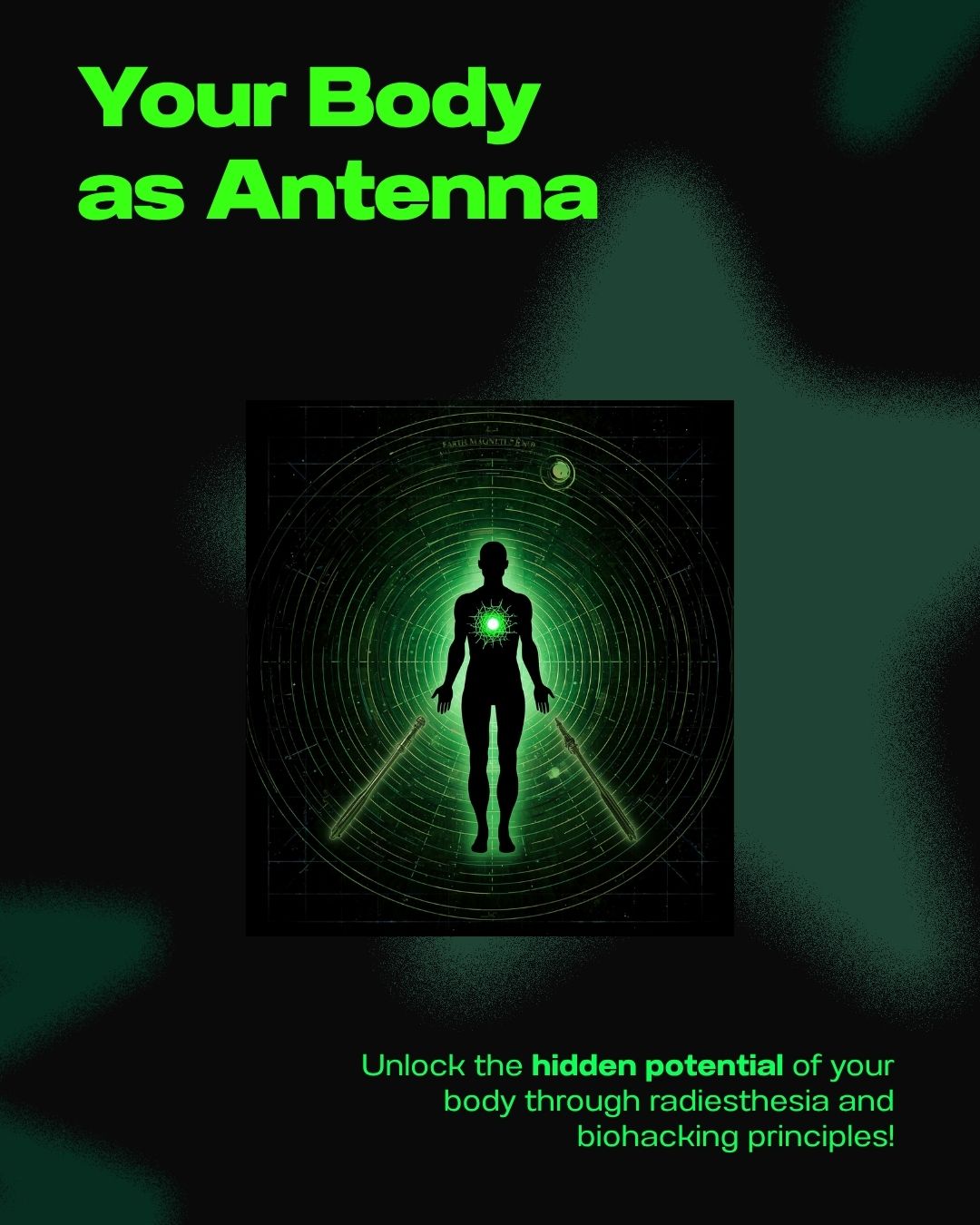
The Art of Sensing Radiation
The word radiesthesia comes from the Latin radius (radiation) and the Greek aisthesis (perception). It means: the perception of radiation. For centuries practiced as dowsing, for just as long dismissed as superstition. But modern science has quietly accumulated evidence that something real is happening — and it is not mystical. It is neurological.
Magnetosensitivity: The Recognized Science
Magnetosensitivity — the ability of biological organisms to detect and respond to magnetic fields — is one of the most documented phenomena in biology:
Your nervous system is detecting magnetic fields right now. You are simply not trained to interpret the signal.
The Instrument Is You
The human nervous system acts as a biological antenna — capable of detecting subtle variations in the Earth's geomagnetic field, including Hartmann and Curry grid crossings, underground water streams, and geological fault emissions.
The pendulum and the dowsing rod are not magic wands. They are amplifiers — mechanical extensions of involuntary micro-muscular movements (ideomotor responses) driven by the nervous system's electromagnetic sensitivity. The body moves the instrument; the instrument makes the movement visible.
The Modern Problem: Electrosmog
We are now immersed in artificial electromagnetic frequencies our biology was never designed to navigate:
This electrosmog overwhelms the biological antenna. Radiesthesia, in this context, is not an anachronism — it is a practice of restoration. Recalibrating the most sophisticated electromagnetic sensor on the planet: your own nervous system.
A Practical First Exercise
Hold L-shaped copper rods (30 cm long, freely rotating in sleeve handles) parallel to the ground and walk slowly across a room in a straight line. Note every position where the rods deviate:
Mark those positions with tape. Walk the perpendicular axis. Where your marks intersect, you have likely found a Hartmann line crossing.
Repeat blind on 3–4 separate occasions to test consistency. With practice, repeatability increases significantly.
The Invisible Is Not Empty
The electromagnetic landscape of your home is as real as its architecture. The grid lines passing through your bedroom are measurable, mappable, and modifiable.
Your body already knows this. The question is whether you will learn to listen.
Based on Volume III of The Biohacker's Guide Collection: Radiesthesia, by César Arce.