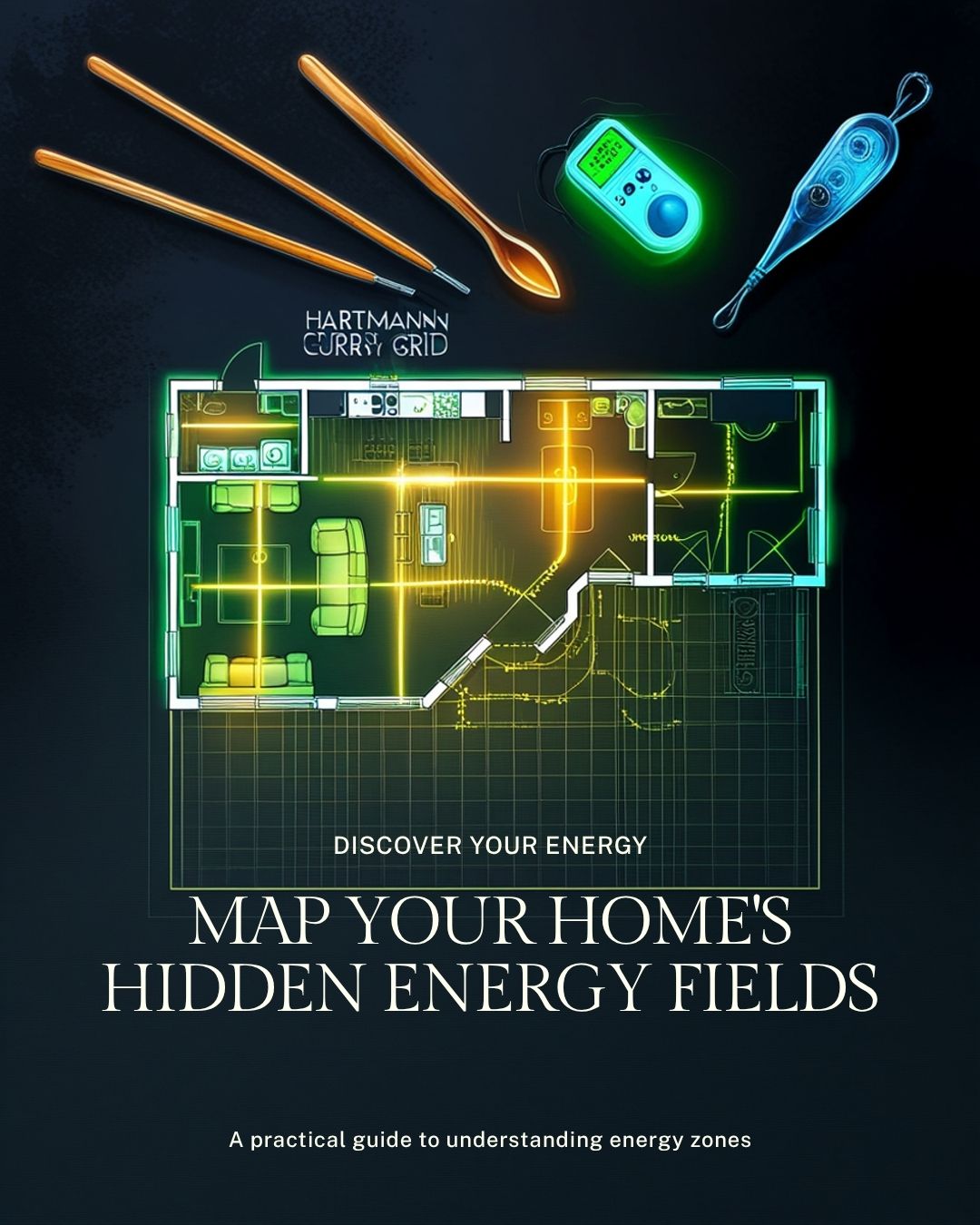
Your Home Has an Invisible Architecture
Every building sits within the Earth's geomagnetic field — and that field is not uniform. Underground water veins create electromagnetic corridors. Geological faults deflect magnetic flow. The Hartmann and Curry grids overlay every square meter of the planet's surface with a measurable electromagnetic lattice.
Most people spend a third of their lives in bed — directly over this invisible architecture — with no idea it exists.
The Tools You Need
L-Rods (Dowsing Rods): L-shaped copper or steel rods, approximately 30–40 cm on the long axis, 12–15 cm on the short handle, mounted in freely-rotating sleeve handles. Drinking straws work perfectly as handles — the rod must rotate freely without gripping.
A Pendulum: A symmetric weight (copper, crystal, or brass) on a 25–30 cm cord, held between thumb and index finger with elbow at 90 degrees. For beginners, establish your baseline: hold over your non-dominant hand and observe the natural rotation direction.
EMF Meter (optional but recommended): A tri-axial ELF magnetometer measuring in milligauss (mG) at 50/60 Hz — available for under $50. Confirms radiesthetic findings with objective measurements.
Step-by-Step: Mapping Your Home
Step 1: Prepare the Space
Turn off WiFi router, mobile data, and as many electrical appliances as practical. Wait 10 minutes. This reduces artificial EMF noise that can mask or mimic geomagnetic readings.
Step 2: Establish Your Outdoor Baseline
Stand outdoors in an open area and hold the rods parallel. Walk slowly north-south in a straight line. Note how the rods respond in undisturbed ground — roughly parallel with minimal deviation. This is your reference point.
Step 3: Map Each Room Systematically
Walk in parallel lines across the room, approximately 50 cm apart. Mark every point where the rods deviate with tape on the floor. Repeat walking the perpendicular axis. Where transition marks cluster, you have located a grid line or underground feature.
Step 4: Identify High-Intensity Nodes
Where two detected lines cross, mark it on a floor plan sketch. Prioritize nodes coinciding with:
Step 5: Confirm with EMF Meter
At each marked node, take a reading. Geopathic nodes often read 1–3 mG above the surrounding background — small in absolute terms but continuous and cumulative over years of exposure.
Radionics: From Detection to Correction
Radionics extends beyond detection into energetic correction. Based on the principle that geometric forms can interact with electromagnetic fields, it provides tools to harmonize detected disturbances.
Paper Radionics Devices: Geometric diagrams incorporating the Seal of Solomon, Sri Yantra, and Lakhovsky oscillator patterns are placed beneath furniture or affixed to floors above detected nodes.
The Lakhovsky Principle: Georges Lakhovsky proposed in the 1920s that every living cell is a biological oscillator. His Multi-Wave Oscillator was designed to restore the natural oscillatory coherence disrupted by geopathic stress — a concept that continues to inform modern copper coil and crystal grid practices.
The Most Effective Intervention Is the Simplest
Moving your bed costs nothing and can be tested in 14 days.
A shift of 50–80 cm can take you completely outside a geopathic zone. Detect first. Move second. Protect third — always in that order.
Based on the Practical Edition of The Biohacker's Guide Collection: Radiesthesia & Radionics Booklet, by César Arce.