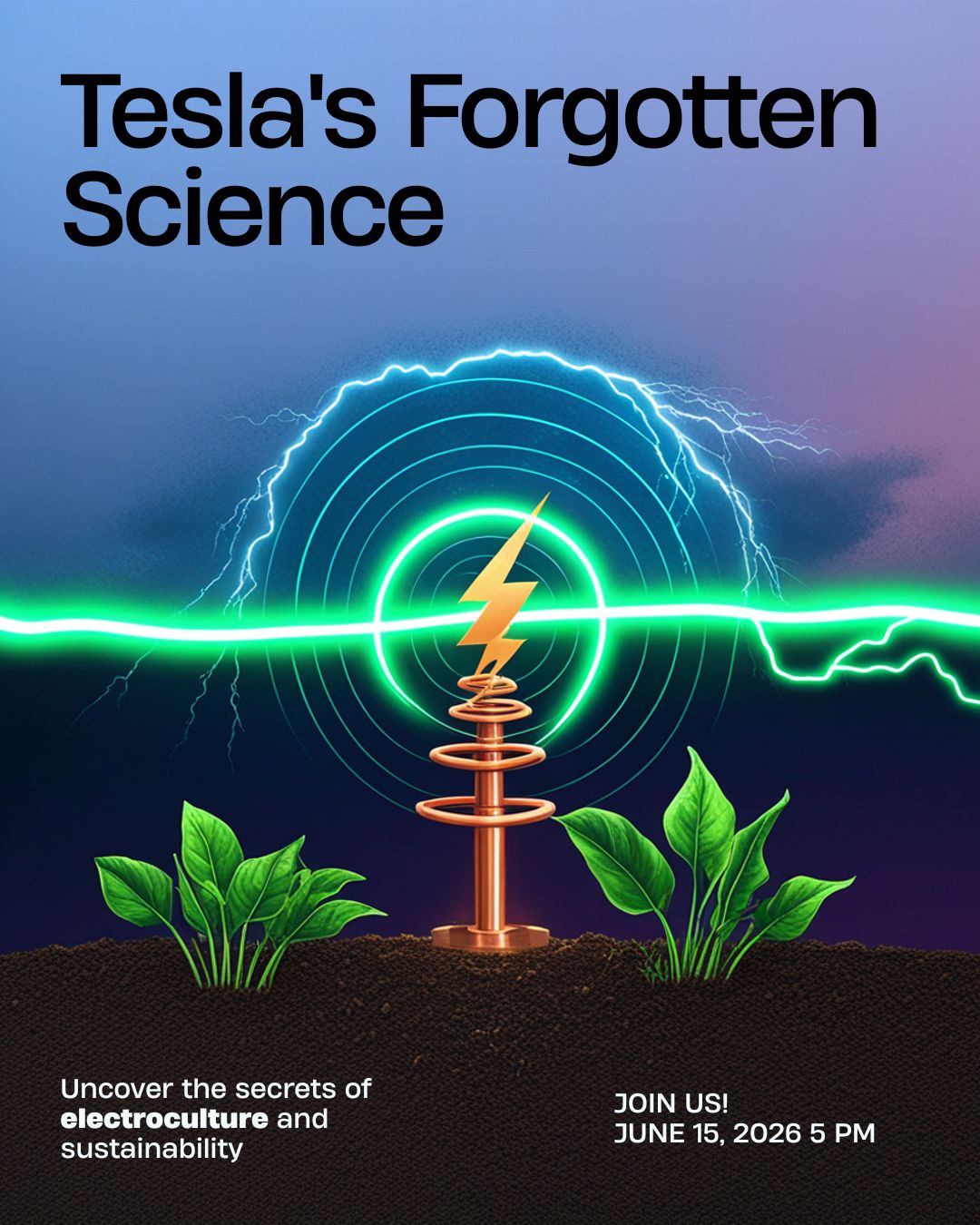
What If the Sky Could Fertilize the Earth?
Imagine that every bolt of lightning, every storm cloud above your head, is more than weather — it is nourishment. An invisible rain of electrons that has always flowed between sky and soil, feeding roots, seeds, and the microbial communities that make life possible.
This is the forgotten secret of electroculture: farming not just with water and minerals, but with the living electricity of the atmosphere.
The Earth–Ionosphere Capacitor
As physicist Richard Feynman explained, the Earth and the ionosphere function as the two plates of a giant spherical capacitor:
Thunderstorms maintain this charge differential. There are approximately 2,000 thunderstorms active on the planet at any given moment, each pumping electrons from ionosphere to ground — maintaining the global electric circuit in steady state. Every root growing in soil exists within this circuit.
A Pilot's Perspective: Static Electricity in the Sky
As a commercial pilot, César Arce observed atmospheric electricity from a unique vantage point. Aircraft continuously accumulate electrostatic charge through friction with air molecules — the triboelectric effect. This charge is managed through static discharge wicks — conductive filaments on wing tips that bleed off accumulated charge into the atmosphere.
The parallel with electroculture is exact. A copper spiral planted in the ground creates a conductive pathway between the atmospheric electrical potential and the soil — feeding it downward, awakening seeds, roots, and the electrochemical processes of life.
Tesla's Dream: Radiant Energy from the Sky
In 1901, Nikola Tesla patented devices (US685957) to capture what he called radiant energy — free electricity falling from the sky. He believed it could power homes, heal bodies, and transform agriculture.
His dream was suppressed. His towers were dismantled. But the physics did not go away.
Justin Christofleau: The First Agricultural Evidence
In 1927, French agronomist Justin Christofleau published landmark documentation of years of experiments with copper spirals, zinc electrodes, and atmospheric antennas inserted into crop fields:
These results were replicated by researchers in Belgium, Austria, and Sweden through the 1930s — then forgotten when the world chose chemical fertilizers after World War II.
The DIY Copper Spiral: Your First Experiment
Materials: 1.5–2 meters of 2mm copper wire, a wooden dowel for winding, wire cutters.
Construction: Wind the wire clockwise around the dowel, creating 7–10 turns, 3–4 cm diameter. Leave 15–20 cm of straight wire as the ground stake. Form a small upward loop at the top — the atmospheric antenna end.
Installation: Drive the stake into the soil 10–15 cm from a plant's stem. The coil sits at soil level; the upward loop rises above the plant canopy.
Protocol: Plant two identical seedlings in equivalent conditions. Install the spiral next to one; leave the other as a control. Observe over 4–6 weeks: germination rate, stem height, leaf count, disease incidence. Document everything.
The Sky Is Alive — and It Is Still Teaching Us
We have not discovered something new. We have remembered something ancient.
Every plant that has ever grown has done so in constant electrical dialogue with the planet and the sky above it. Electroculture is an invitation to rejoin that conversation.
Based on Volume V of The Biohacker's Guide Collection: Electroculture, by César Arce.